One way we love to help you make iGoogle your own is with our artist and designer themes — ranging from food and fashion to games and comics. Today, we’re excited to announce a set of new themes, tailored to the world traveler in all of us. These new themes, focused on destinations all over the globe, allow you to experience beautiful landscapes, historic monuments, stunning beaches, iconic cities and other picturesque sites — right from your homepage.
To bring you this imagery, we've partnered with a few leading organizations including National Geographic Society and LIFE, who photograph some of the most breathtaking destinations on earth. Lonely Planet, UNESCO and visiteurope.com have also shared a selection of incredible images.
Here’s a quick preview of some of what you’ll find:
* The World Passport Sampler theme, which brings together many of the great destinations.
* India, Greece and Egypt, all captured spectacularly by National Geographic.
* Classic beach destinations from LIFE.com, including Monte Carlo, Waikiki Beach, and the French Riviera.
* Incredible vistas from Spain, Italy, Thailand and Japan, captured by Lonely Planet.
* The opportunity to view World Heritage sites, such as the Sydney Opera House and the Old City of Dubrovnik in Croatia, provided by UNESCO.
2010-04-02
All Over World 25 iGoogle Themes
2009-11-04
Have a Look At NASA’s Social Media
Whenever I talk with new clients about social media initiatives, one of the key points is having a social media plan or strategy. Social media is a time and resource intensive effort, and if you spend the time up front developing a plan, you can distribute the work and make the overall project more effective in the long run. In this column, I’d like to take a look at how the National Aeronautics and Space Administration (aka NASA) tackles social media.
Everyone has social media channels that they prefer to use, and by creating a social media hub with links to all of the social media areas they participate in, it makes it easy for end users, and search engines to discover them. Another interesting and noteworthy point, is that NASA has chosen to divide content into different channels, by mission. For example, there is a Facebook Channel for the Ares I-X program, a Flickr channel , a Twitter channel, and a YouTube channel. What this does is give them the flexibility to cross-post the best content. The best photos from Flickr and videos from YouTube were cross-posted into the Facebook account. But the Facebook account has other pictures that aren’t in the Flickr account. There’s overlap, but each channel has unique content or value add.
Another sticking point that many organizations face when engaging in social media is controlling the message. Many organizations favor a top down, tightly controlled, output of information. In fact, the NFL and Dreamworks Animation are inserting clauses and restrictions on Twitter usage for employees. In a recent interview about how NASA uses Twitter, it was revealed there are over 100 NASA employees using Twitter. While there isn’t an official policy in place, they do ask everyone to abide by their “release of government information guidelines” when using social media.
To get the most out of social media, it’s important for information be released in a timely fashion. Creating bottlenecks of very small groups of people who are allowed to publish/approve will limit your success. Instead, set up some ground rules, and let everyone who agrees to abide by them to publish freely. When you do, you end up with interesting and unexpected results, like this TwitPic of a spent rocket booster from the Ares X-1 launch bobbing in the ocean waiting to be recovered.
A New Search Options in Google: Page Preview Option
Google Operating System noticed Google has added a new search option named “page preview.” If you go to Google, search on something and click on “show options,” you can then look towards the button on the left hand side and click on “page previews.” For example, here is a view of a search for apple with page preview selected.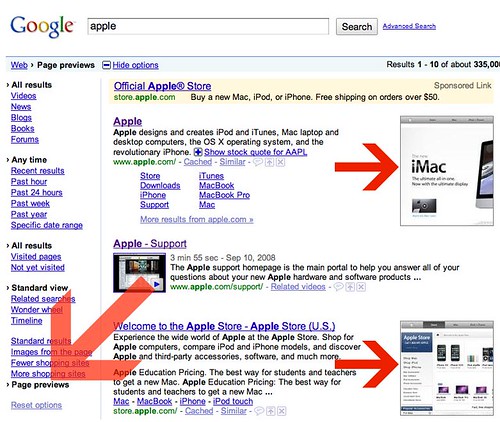
New look and feel for the MSN portal - Drives Nearly 50% Of Bing Queries
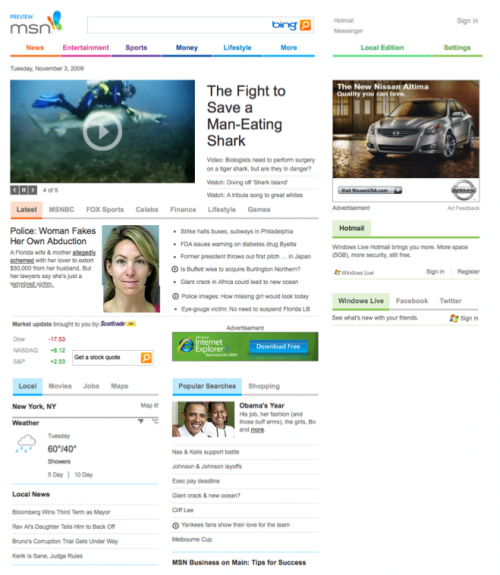
Billed as the first major redesign in a decade, Microsoft has introduced a dramatic new look and feel for the MSN portal. The redesign simplifies and cleans up most elements on the site. Among other things, it makes video more central, incorporates Facebook and Twitter, creates a dedicated new local area and emphasizes search.
MSN, which Microsoft says now has 600 million users globally (which would make it larger than Yahoo), is a huge asset for a number of reasons, not the least of which is the fact that it drives roughly 45% of Bing’s queries. Even a cursory look at the old and new MSN homepages reveals the superiority of the new design:

2009-10-31

2009-09-21
SMO Ranking Factor
SMO Ranking Factor:
Intro to Social Media Optimization
Social Media Optimization (SMO) is a new term that was recently coined in Search Industry and has since been taking on life of its own. In his introduction to SMO, similar comparisons to SEO. SMO tactics can drive huge amounts of people to a website and can also determine whether a startup, website or idea will make it or not. It involves driving traffic to a website through new channels because search engines aren't the only sites that drive big traffic anymore. While it's not taking over SEO yet, it has the potential to someday soon.
First of all "social media" is a buzzword that has been thrown around a lot lately. But what exactly does it really mean? Wikipedia describes social media as...
the online tools and platforms that people use to share opinions, insights, experiences, and perspectives with each other. Social media can take many different forms, including text, images, audio, and video. Popular social mediums include blogs, message boards, podcasts, wikis, and vlogs.
Also, social media can be considered anything that can help build a community to rally around. Companies/websites such as Digg, Delicious, Facebook, and Revver all fit the bill. These are all websites that can now be used as places to put out your marketing message. Spreading messages through blog posts and blog search engines also fits the bill. It is all about making something easy to spread, which, by the way, used to be called word-of-mouth. Buyer beware though, you can't force SMO. This is pull marketing; it is not "push your message onto someone marketing".
With SEO the goals are clearly defined, you're trying to make a website visible in the search engines. Is SMO really as simple to define as making your site visible in the social media? Does that entail anyway possible and include buying banner ads on MySpace?
the main goals of...
The concept behind SMO is simple: implement changes to optimize a site so that it is more easily linked to, more highly visible in social media searches on custom search engines (such as Technorati), and more frequently included in relevant posts on blogs, podcasts and vlogs.
... and then he lays out 5 rules for SMO...
1. Increase Your Linkability
2. Make Tagging and Bookmarking easy
3. Reward Inbound Links
4. Help Your Content Travel
5. Encourage the Mashup
...Jeremiah Owyang gives us a couple more rules...
1. Be a User Resource, Even if it Doesn't Help You
2. Reward Helpful and Valuable Users
In way it sounds a whole lot like Marketing 2.0. It is pretty much includes all the new marketing techniques that are becoming popular rolled into one, techniques such as; Linkbaiting, Usability Design, Buzz Marketing, Community Building, and anything that can be considered "pull marketing".
Here's a few more possible rules...
8. Participate - Join the conversation. Social Media is a two way street, lets not forget that. By conversing with the community you are creating awareness and prolonging your buzz. You are keeping it going and this often results in a snowball effect. Participating helps your message spread further and faster.
9. Know how to target your audience - If you don't even know your target audience you are in trouble. I would love to have everyone using my product too, but you need to be realistic. There is always going to be a certain audience you can appeal to and others that you can't. So know your appeal and who it is appealing to.
10. Create content - There are certain kinds of content that just naturally spread socially. It does not matter what industry you are in and what boring products you sell, there is always some kind of content that can be created that will work. Whether it is creating widgets, making people laugh, or writing a whitepaper, it can be done. Know what type of content can work for you and create it.
11. Be real - The community does not reward fakers.
While social media optimization is becoming very important you can't forget about good old SEO either. Google and Yahoo still drive mass amounts of traffic and you ca not ignore them. It is all about leveraging new mediums and riding these waves. Even though you might be getting dirt on the white glove you still have to take advantage of these powerful channels.
Top 10 Social Bookmarking Sites
The number of social bookmarking sites has exploded in the last year, leaving someone new the space probably a bit overwhelmed at where to start. If you are new to social networking understand that each social networking site is different, it attracts a different audience with different interests. Thus what interests someone on Reddit might not appeal to anyone on Digg.So who are the main players in the social bookmaking space? And what is the profile of the typical user of these social bookmarking sites? The answers below might surprise you!
Digg.com
Digg is the most popular and notable of the social bookmarking sites. Quantcast estimates that that Digg has about 25 million unique visitors a month. The audience is predominantly male (65%), between 25-34 years of age, with a household income between 30k and 100k. Digg’s demographics have changed as it has become more popular (mainstream). Not to long ago the Digg profile was male, under 25 who made less than 30k a year. Social media topics that do well on Digg include interesting photos, anything anti-Microsoft and lists (top 10, etc).
Propeller.com
Propeller (formely Netscape) is comfortable the second biggest social bookmarking site behind Digg with over 5.8 million monthly uniques, of which 3.6 million (62%) are in the U.S. Netscape also attracts a male biased audience (54) , that is slightly older (45-54 is biggest age group), and 55% of Propeller.com visitors have an household income over $60k.
StumbleUpon
Stumbleupon.com reports over 4.5 million members and Quantcast classifies it as a top 5,000 site that has about 1.5 million unique visitors a month from the U.S. The audience is male biased (56%) and between the ages of 45-54 (22% of visitors). The older demographic also skews the household income with 51% of visitors having a household income of over $60k.
Reddit.com
Reddit is becoming a very popular social bookmarking site with about 1.2 million unique visitors in the U.S., making it slightly larger than Del.icio.us. Reddit attracts a predominantly male (57%) audience that is between the ages of 35-44 (25%). With 65% of the audience having a household income of between $30 and $100k, Reddit is a mainstream social networking site. As a result, political, environmental, business and entertainment news does well with this audience.
Del.icio.us
Del.icio.us is the oldest social bookmarking site and Quantcast classifies it as a top 5,000 site that gets about 1.1 million unique visitors a month from the U.S. The audience is male (53%) and about 47% of them are over 45. Similar to StumbleUpon, 51% of visitors having a household income of over $60k.
Newsvine.com
Newsvine is a top 10,000 site that reaches over 362K U.S. monthly uniques. The site attracts a slightly male slanted audience (54%) and 51% of the users have a household income under $60k.
Fark.com
Fark.com is a much more trafficked site than people expect. With 1,972,698 monthly unique visitors in the U.S., it is bigger than StumbleUpon, Del.icio.us and Reddit. The Fark audience is heavily male (69%), between the ages of 25-34 and a household income under $60k (52%). The Fark audience likes interesting, bizarre and amusing news stories, along with regular photo manipulation contests.
Blinklist.com
Blinklist.com is a top 10,000 site that reaches over 353K U.S. monthly uniques. The site appeals to a more male group (59%) who are between the age of 25 and 54. About 54% of the audience earns over $60k a year.
Clipmarks.com
Clipmarks reaches over 205K U.S. monthly uniques. The site appeals to a male biased audience (58%) with a household income of $30-60k. The site attracts almost equal amounts of people between 25 and 54.
Shoutwire.com
This site reaches approximately 70,742 U.S. monthly uniques. The site appeals to a more male (60%), younger audience (38% are under 24).
So what does the demographic data tells us? One is that the typical social bookmarking site user is male, between the ages of 35-54 with a household income of $60k or more a year. Is this your target audience? If it is not, then these are probable not the main social networking sites that you should be focusing on.
Yahoo SEO
See More SearchMonkey in Your Search Results:
Want a little more SearchMonkey in your Yahoo! search results? Starting today, more enhanced results for product, local, entertainment, reference, social, and tech sites will appear automatically in your results, putting more information and answers right at your fingertips.
First, we’d like to thank everyone who deployed microformats, RDFa, and feeds in response to our blog post in May. Thanks to your efforts, we’ve finished user testing for the new enhanced results templates and have deployed these templates in production. This means that in addition to Video, Documents, and Games, you can now add Products, Local Businesses, Event, Discussions, or News items to your pages. Anyone who provides structured data according to the specified format will automatically gain SearchMonkey default-on status, as long as it adheres to our terms of use...More
Google Adds Books to Search Options Panel
Google Adds Books to Search Options Panel:
Earlier this year, Google introduced the Search Options panel to its main search. The options allow search results to be filtered by things like time or content type.
Now, Google is adding Books as a filter on the Search Options panel. Take a look and let us know what you think by leaving a comment below.
